


A look inside
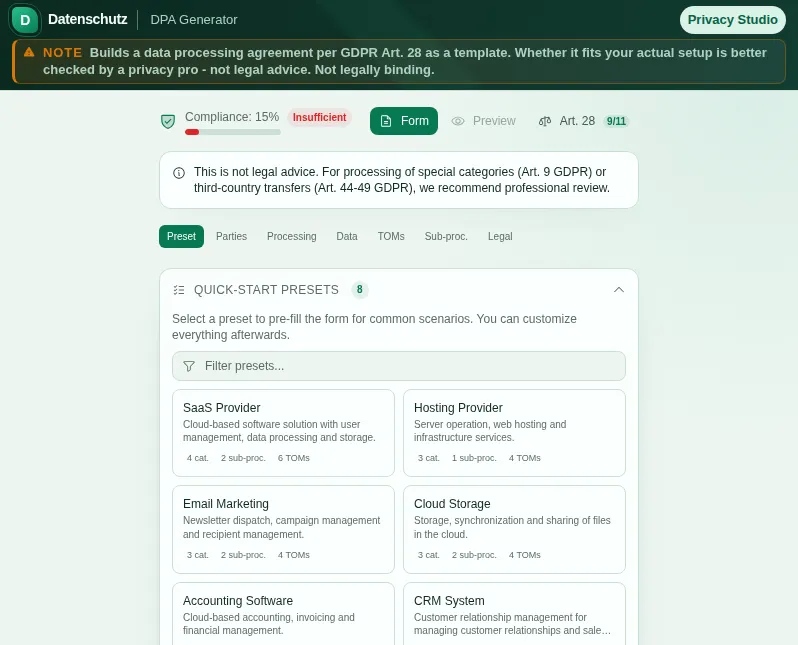
This safe preview shows what the tool is for without running account-only actions.
What DPA Generator does
The data processing agreement, DPA for short, is one of the most frequently overlooked GDPR obligations. Anywhere an external service provider processes personal data on your behalf, Art. 28 GDPR requires a written contract with a fixed minimum content. This affects more cases than most think: email marketing, cloud storage, accounting software, support systems, web hosting. Without the DPA the processing is formally unlawful and, in the worst case, subject to fines.
The DPA generator takes the drafting off your hands. It guides you in clear steps through the parties (controller and processor), the subject and nature of the processing, the categories of data subjects and data, the technical and organizational measures, the sub-processors and the legal clauses. Ready presets for typical service-provider constellations give you a sensible starting point.
The core is the technical and organizational measures, the TOMs under Art. 32 GDPR. The generator structures them into nine categories: the eight customary in practice (physical access, system access, data access, transfer, input, job, availability and separation control) plus review & organisation with regular testing under Art. 32(1)(d) GDPR, training and an incident process. For each category you select the fitting measures instead of formulating them from nothing.
A point where many DPAs fail is the third-country transfer. As soon as a service provider or its sub-processor sits outside the EU, you need a valid transfer mechanism - an adequacy decision or standard contractual clauses (SCC). The generator detects from the location whether a third-country transfer exists and points out whether and which transfer mechanism is needed, so you do not overlook it.
Sub-processors are managed systematically. When your service provider itself engages further providers, the DPA must govern this, including authorization and the passing on of duties. The generator manages the sub-processors as a list, checks their locations for third-country relevance and includes them in the contract. On top there is an Art. 28 checklist as a checking aid that shows which core points your form already covers.
Honesty is part of it: a generated DPA is a solid, GDPR-oriented foundation, but for delicate constellations it does not replace review by a data protection officer or specialist lawyer. For most standard cases with common service providers it is a solid working basis. Everything runs data-frugally, and you export the finished document as PDF, ready for signature by both sides.
Features
Art. 28 building blocks
The minimum content under Art. 28 GDPR as building blocks, from the parties to data subject rights. Review before signing.
Nine TOM categories
Physical, system, data-access, transfer, input, job and availability control, the separation requirement plus review & organisation per Art. 32 GDPR.
Third-country transfer check
The generator detects a third-country link from the location and then adds a clause under Art. 44-49 GDPR (adequacy decision such as the Data Privacy Framework, standard contractual clauses or Art. 49).
Sub-processor management
Manage sub-processors as a list, check their locations and include them cleanly in the contract.
Art. 28 checklist
A checking aid shows which core points of Art. 28 GDPR your form already covers. Not a legal assessment.
PDF export
Export the finished document as PDF, ready for signature by controller and processor.
How it works
- 1
Pick a preset
Pick a fitting preset for your service-provider type or start freely.
- 2
Enter parties and processing
Enter controller and processor, subject, nature and purpose of processing, plus data and subject categories.
- 3
Select TOMs and sub-processors
Select the fitting measures from the nine TOM categories and record sub-processors including their location.
- 4
Check and export
The Art. 28 checklist shows what is still missing in the form. Then download the PDF and review it before signing.
Who needs this
Frequently asked questions
When do I need a data processing agreement?
Whenever an external service provider processes personal data on your behalf, such as your newsletter tool, cloud host, payroll office or support system. Art. 28 GDPR requires a written contract with a fixed minimum content for this. Without a DPA the processing is formally unlawful and can trigger fines.
What are TOMs?
TOMs are the technical and organizational measures under Art. 32 GDPR with which the processor protects the data. The generator structures them into nine categories such as physical access control, data access control, availability control and review & organisation. For each you select the concrete measures your provider implements.
What about service providers outside the EU?
Then a third-country transfer exists, which needs a valid transfer mechanism, such as an EU Commission adequacy decision or standard contractual clauses (SCC). The generator detects from the location whether a third-country link exists and flags the required mechanism, so the transfer stays lawful.
How are sub-processors handled?
If your provider itself engages further providers, the DPA must govern this, including your authorization and the passing on of data protection duties. The generator manages the sub-processors as a list, checks their locations for third-country relevance and includes them in the contract.
Does the generated DPA replace legal advice?
No. It is a solid, GDPR-oriented foundation for standard cases with common service providers. For delicate or complex constellations, such as extensive third-country transfers or special data categories, review by a data protection officer or specialist lawyer is advisable.
Related tools

GDPR Art. 30 Helper
Create your GDPR Article 30 records of processing activities. All required fields, ready to p…

TOMs Generator
Create your GDPR Article 32 TOMs document. Fill out the questionnaire, download PDF, done.

Deletion Concept Generator
Create a reviewable draft covering data categories, retention periods, and deletion methods.…
DPIA Quick Check
Check if a DPIA per Art. 35 GDPR is required. Short questionnaire, clear result.

Terms & Conditions Generator
Generate German terms and conditions (AGB) structured along German law for online shops, serv…

Clause Switcher
Combine 13 contract clauses in 3 severity levels (mild/standard/strict). Risk scoring, preset…
Ready to use DPA Generator?
No installation. Included from Plus. Open it right in your browser.
Open now