


A look inside
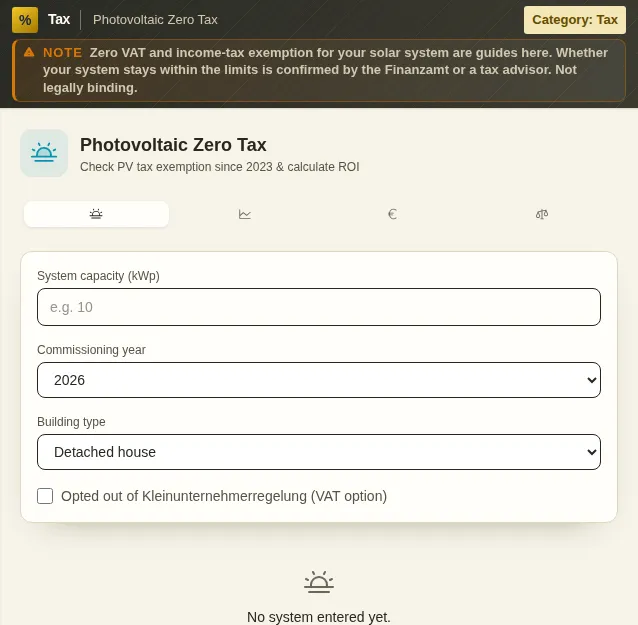
This safe preview shows what the tool is for without running account-only actions.
What Photovoltaic Zero Tax does
Two tax laws fundamentally simplified private photovoltaics from 1 January 2023. Section 3 No. 72 of the Income Tax Act exempts income from operating smaller PV systems from income tax. Section 12 para. 3 of the VAT Act sets the VAT rate for delivery and installation to 0% - the so-called zero rate. Together that means: no more tax hassle for most rooftop systems.
The income-tax exemption depends on capacity limits. For a single-family home, up to 30 kWp (gross capacity per the market master data register) is exempt. For multi-family and mixed-use buildings, 15 kWp per residential or commercial unit applies, capped at a maximum of 100 kWp per taxpayer across all systems. The calculator knows this tiering and tells you, for your building type, exactly whether you are under or over.
The zero VAT rate is even simpler: for delivery and installation on or at residential and public buildings, no VAT has been charged since 2023 at all. That covers the solar modules, the inverter, the battery storage and all essential components. Because the purchase price is already net, there is no input tax left to deduct - so the small business scheme is automatically the default for new systems.
The calculator also covers the legacy cases. Systems commissioned before 2023 do not benefit from the zero rate - 19% was paid there. The income-tax exemption, however, applies retroactively to older systems too, as long as the capacity limits are met and the tax assessment is still open or amendable. Anyone who opted for standard taxation back then is sitting out the five-year lock-in under Section 19 para. 2 of the VAT Act.
Alongside the tax check there is a profitability calculator. You enter purchase cost, annual yield, self-consumption ratio, electricity price, degradation and maintenance cost, and the tool projects savings and feed-in revenue over 20 years, including payback period and annual return. A small bar chart shows the progression of self-consumption, feed-in and cumulative benefit.
The feed-in tariff is based on Section 21 para. 1 EEG 2023: the calculator lists the current rates per half-year, split by partial and full feed-in and by capacity class. Rates drop by 1% every six months, so earlier installation locks in the higher rate for 20 years. For the standard calculation the tool uses the current rate for small systems with partial feed-in.
Every calculation path is backed by its legal section, plus the BMF letter of 17 July 2023 as a source and a before-and-after overview of what changed in 2023. You can copy the result. The calculator is an orientation, not tax advice - for your specific case the tax office or your tax advisor remains responsible.
Features
Income tax exemption (§ 3 No. 72)
Checks the capacity limits of 30 kWp for detached homes and 15 kWp per unit up to 100 kWp per taxpayer.
0% zero VAT rate (§ 12 para. 3)
Shows whether purchase and installation are VAT-free, including modules, inverter and battery storage.
Building-type tiering
Single-family, two-family, apartment, commercial and mixed-use buildings with their respective limits.
20-year ROI
Payback period, total benefit and annual return from cost, yield, self-consumption and degradation.
EEG feed-in tariff
Current rates per half-year under § 21 EEG 2023, split by partial and full feed-in and capacity class.
Legacy systems covered
Retroactive income-tax exemption for pre-2023 systems and the note on the VAT option with a 5-year lock-in.
Runs in the browser
Tax check and ROI compute locally, your system data stays on your device. Result is copyable.
How it works
- 1
Enter capacity and year
Enter your system's kWp and the commissioning year - decisive for the zero rate from 2023.
- 2
Pick the building type
Detached, apartment or mixed-use - for multiple units you enter their number.
- 3
Read the tax status
Two badges show income tax and VAT, and below the tool explains why.
- 4
Check profitability
In the ROI tab you enter cost and yield and see payback, return and the 20-year progression.
Who needs this
Frequently asked questions
Up to what size is my PV system tax-free?
The income-tax exemption under Section 3 No. 72 applies up to 30 kWp for detached homes and outbuildings, and up to 15 kWp per residential or commercial unit for multi-family and mixed-use buildings, capped overall at 100 kWp per taxpayer. The gross capacity per the market master data register is decisive.
Do I pay 0% or 19% VAT on the purchase?
Since 1 January 2023 a zero rate of 0% applies to delivery and installation of PV systems on or at residential and public buildings (Section 12 para. 3). That covers modules, inverters, battery storage and all essential components. For pre-2023 systems, 19% was paid instead.
Do I have to tax the feed-in revenue?
No, provided your system falls under the income-tax exemption. Then the feed-in revenue is tax-free, as is the value of the electricity you consume yourself. The exemption applies regardless of whether you feed in or use the power.
Is claiming input tax still worthwhile?
Not for new systems since 2023. Because the purchase price is already billed at 0% VAT thanks to the zero rate, there is no input tax to deduct. The small business scheme is therefore the default. The question only remains relevant for legacy systems with an active VAT option.
Does the zero rate also apply to battery storage?
Yes, provided the storage is delivered with the PV system or retrofitted, and the system meets the limits. The storage must be an essential component of the system. The inverter and the essential components are covered too.
What applies to systems built before 2023?
The income-tax exemption applies retroactively to legacy systems if the capacity limits are met and the tax assessment is still open or amendable. The 0% VAT rate, however, only applies to deliveries from 1 January 2023 - older systems were bought at 19% VAT.
Related tools

VAT Calculator
Calculate net and gross prices with 19% or 7% German VAT or a custom rate. Free, no signup re…

Small Business Tax Check
Check if you still qualify for the German small business tax rule (§ 19 UStG). With 2026 thre…

Income Tax Calculator
Calculate German income tax per § 32a EStG. Basic and splitting tariff, solidarity surcharge,…

Loan Repayment Calculator
Calculate your loan repayment schedule with monthly payments, total interest and extra payments.

Mini-ELSTER Wizard
Prepare your ELSTER tax return: select Anlage N/S/V/KAP/R, create document checklist, check f…

Tax System 101
The German tax system explained clearly: tax classes, deadlines, and all major tax types. Ide…
Ready to use Photovoltaic Zero Tax?
No installation. Included from Plus. Open it right in your browser.
Open now