


A look inside
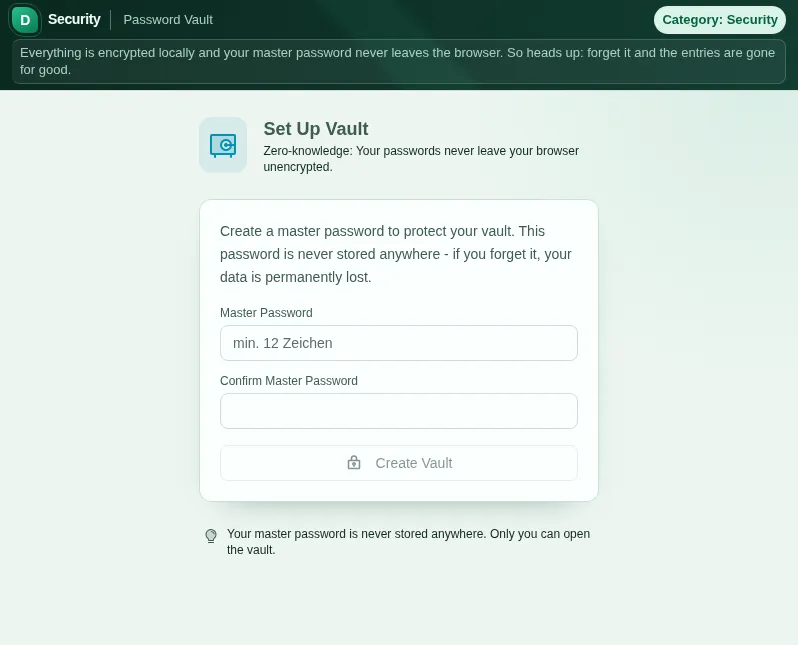
This safe preview shows what the tool is for without running account-only actions.
What Password Vault does
A password manager is only as trustworthy as its architecture. That is why the Passwort-Tresor is built strictly zero-knowledge: every entry is encrypted on your device before it is stored anywhere. Encryption runs through your browser Web Crypto API with AES-256-GCM, and the key is derived from your master password via PBKDF2 with 1,000,000 iterations. Your passwords exist in plain text only in the moment you look at them.
The master password never leaves your device. It is not stored, not transmitted, not hashed and kept anywhere - it is used solely to derive the key locally. The honest flip side: if you forget it, nobody can reset it. No support, no reset link, not even us. That is the whole point of the architecture: what we do not know, we cannot lose or hand over.
In daily use the vault behaves like a tidy desk. Entries have a title, username, password, URL and notes, can be sorted into categories, marked as favorites and searched. The built-in generator creates strong passwords right when you add an entry, removing the classic excuse of not being able to think of one.
The security audit shows you where it hurts: weak passwords, reused passwords and entries that have not been changed in ages. That is how you work off the legacy from the era when the same password with an exclamation mark at the end was used everywhere.
Where the vault lives, honestly: encryption happens in your browser, and exactly that encrypted vault is kept in your account. So it is there in every browser and on every device where you sign in, also after clearing the site data. Your master password and the keys are never sent to us. A regular encrypted backup never hurts, though.
Switching over does not mean starting from zero: CSV exports from LastPass, Bitwarden, KeePass and KeePassXC import directly, multi-line notes included. In the other direction you create an encrypted JSON export as a backup. "Restore backup" loads it again, also in another browser: pick the file, enter the backup master password, then replace or merge. If you keep the backup in the Aktenschrank, only the encrypted file is stored there.
For everyday protection there are the mechanisms you only miss once they are gone: auto-lock after a configurable idle time (5 to 60 minutes or never), and copied passwords are automatically removed from the clipboard after 30 seconds. An open vault on an unattended computer remains a risk though - even the best encryption does not protect against the colleague walking past your unlocked screen.
Features
Zero-knowledge architecture
Encryption and decryption happen exclusively on your device. Only ciphertext is ever stored.
AES-256-GCM + PBKDF2
Web Crypto API with AES-256-GCM, key derivation via PBKDF2 with 1,000,000 iterations and SHA-256.
Security audit
Spots weak, reused and long-unchanged passwords at a glance.
Import from other managers
CSV import from LastPass, Bitwarden and KeePass - switching takes minutes, not evenings.
Encrypted backup
Backup as an encrypted JSON file, and "Restore backup" with the backup master password - replace or merge.
Auto-lock
The vault locks itself after a configurable idle period - 5, 15, 30 or 60 minutes. Your choice is remembered.
Clipboard self-clears
Copied passwords are automatically removed from the clipboard after 30 seconds.
Organisation built in
Categories, favorites, search and an integrated password generator right where you add entries.
How it works
- 1
Create your vault
Choose a strong master password - ideally a long passphrase. It is the only key and cannot be reset.
- 2
Add or import entries
Add credentials one by one or import the CSV export from LastPass, Bitwarden or KeePass.
- 3
Work through the audit
Open the security audit and replace weak and duplicate passwords with the built-in generator.
- 4
Daily use: copy and let it lock
Copy passwords as needed - the clipboard clears after 30 seconds and the vault locks itself when idle.
Who needs this
Frequently asked questions
Where is my vault stored, and what happens when I sign out?
Your vault is encrypted in your browser and kept in your account in that encrypted form. Signing out does not delete it, and in another browser or on another device it is back after you sign in. Only you can open it, with your master password. You can also make an encrypted backup at any time and load it with "Restore backup".
What exactly does zero-knowledge mean?
All entries are encrypted and decrypted on your device. Only ciphertext is ever stored, and the master password never leaves your device. Nobody but you can read the contents - not even us. No software can promise absolute security, but the architecture ensures there simply is no plain-text copy of your passwords outside your device.
What happens if I forget my master password?
Then the data is gone - honestly and irrecoverably. There is no reset and no backdoor, because the master password is not stored anywhere. That is exactly where the vault gets its trustworthiness from. So pick a memorable passphrase and keep an encrypted export as a backup.
Can I migrate from LastPass, Bitwarden or KeePass?
Yes. Export your entries there as CSV and import the file into the vault. Entries are encrypted locally the moment they are imported. Afterwards you should delete the unencrypted CSV file - it is the only plain-text intermediate step.
What encryption is used?
AES-256-GCM via your browser Web Crypto API. The key is derived from your master password via PBKDF2 with 1,000,000 iterations and SHA-256. These are established, openly documented standards - no home-grown crypto.
Does a copied password linger in the clipboard?
No. Copied passwords are removed from the clipboard automatically after 30 seconds so they do not get pasted somewhere by accident. On top of that, the vault locks itself after a configurable idle period.
Related tools

Password Generator
Generate cryptographically secure passwords and passphrases. Customize length and character s…

Password Expiry Calendar
Plan your account check at the interval you choose and get calendar reminders. ICS export for…

Hash Verify
Calculate MD5, SHA-1, SHA-256, SHA-384, SHA-512 hashes and HMAC. Hash files and text, verify…
Email Encryption
Encrypt, decrypt and sign messages with RSA-OAEP, AES-256-GCM and RSA-PSS, entirely in your b…
Ready to use Password Vault?
No installation. Included from Plus. Open it right in your browser.
Open now