



A look inside
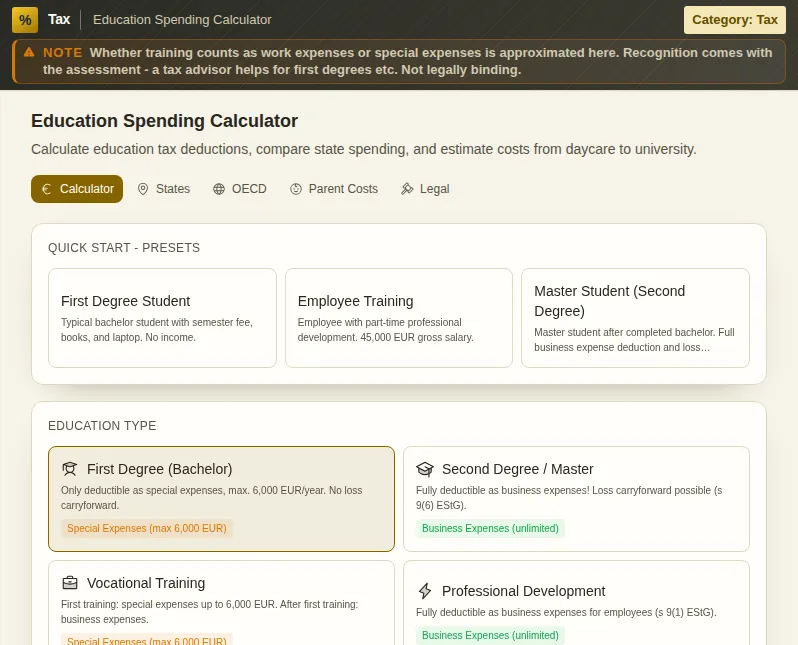
This safe preview shows what the tool is for without running account-only actions.
What Education Spending Calculator does
The big lever with education costs is the question: work-related expenses or special expenses? It sounds like nitpicking but it decides thousands of euros. Work-related expenses are deductible without a cap and can be carried forward into later years as a loss - ideal when you have little or no income during your studies. Special expenses are capped at 6,000 EUR a year and are lost if you cannot offset them against income in the same year. The Education Spending Calculator maps your situation to exactly this fork.
The line runs between first and second training. A first degree straight after school or a first vocational training is deductible only as special expenses up to 6,000 EUR under Section 10(1)(7) EStG, and a loss carryforward is excluded. That is the painful rule many students have challenged in court without success. But once you have completed a first qualification everything flips: a master, second degree, retraining and any professional development are fully deductible as work-related expenses under Section 9 EStG.
And that is exactly where the loss carryforward trick sits. As a master student without income you accumulate your work-related expenses - semester fee, textbooks, laptop, a second home at the study location, travel - year after year and carry them forward as a loss. When you then earn properly in your first working years, you offset that accumulated loss against your salary and reclaim tax in a bundle. The calculator makes this mechanism visible instead of hiding it in tax jargon.
For on-the-job development the situation is simplest: work-related means fully deductible expenses under Section 9(1) EStG. Course fees, technical literature, travel to the course location, overnight stays - it all counts as long as there is a job connection. Retraining after a completed first qualification also falls into this category and is therefore treated much more favourably than a first degree.
Beyond the tax side, the calculator helps you get an overview of the raw costs: semester fees differ by federal state and university, plus rent, living costs and study materials. The maximum BAföG rate and typical cost blocks from daycare to university are built in so parents and students can plan realistically what adds up over the years.
Everything computes locally in your browser without a single figure going to a server. The calculator does not replace tax advice - whether your specific case counts as first or second training can be tricky, and case law keeps evolving. Take the results as well-founded orientation into your tax return or a conversation with your tax advisor.
Features
Work-related vs. special expenses
The calculator sorts your spending into the right category and explains why that decides the cap and loss carryforward.
Special expenses cap 6,000 EUR
For a first degree and first training under Section 10(1)(7) EStG a maximum of 6,000 EUR a year is deductible, with no carryforward - the calculator checks against this.
Loss carryforward made visible
For a second degree under Section 9(6) EStG the calculator shows how accumulated work-related expenses later offset against your salary.
Development and retraining
Job-related development and retraining after a completed first qualification are set up as fully deductible work-related expenses.
Cost blocks from daycare to university
Semester fee, rent, study materials and typical parent costs over the years - realistic instead of guessed.
Federal state comparison
Semester fees and conditions differ by federal state - the calculator makes the differences tangible.
Runs locally, no data sent
Your numbers stay in the browser. No signup, no transfer, works offline.
How it works
- 1
Choose your education path
First degree, second degree or master, development or retraining - the calculator then sets the right tax category.
- 2
Enter your costs
Semester fee, textbooks, laptop, home at the study location and travel - as completely as possible.
- 3
Read off classification and saving
The calculator shows whether it is work-related or special expenses, whether carryforward applies and how much tax you save.
- 4
Transfer into your tax return
Take the classification into Annex N or the special expenses and check edge cases with your tax advisor.
Who needs this
Frequently asked questions
Can I deduct my first degree from tax?
Only to a limited extent. A first degree straight after school counts as special expenses under Section 10(1)(7) EStG and is capped at 6,000 EUR a year. A loss carryforward into later years is excluded, which is why the costs often fizzle out if you have no income during your studies.
Why is a second degree better for tax?
After a completed first qualification a master, second degree and retraining are fully deductible as work-related expenses under Section 9 EStG, with no cap. Above all a loss can be carried forward: you accumulate the costs and offset them later against your salary in your first working years.
What is a loss carryforward?
If your deductible work-related expenses in a year exceed your income, a tax loss arises. You can carry this forward into future years and offset it there against your then higher income - so your study costs are not lost.
Does on-the-job development count as work-related expenses?
Yes. Job-related development is fully deductible as work-related expenses under Section 9(1) EStG - course fees, technical literature, travel and overnight stays included, as long as there is a connection to the job you do.
What can I claim as study costs?
Typical items are semester fees, textbooks and technical literature, a laptop, a second home at the study location, plus travel to university and internships. The calculator lists the common blocks so you forget nothing.
Does the calculator replace tax advice?
No. Whether your case counts as first or second training can be disputed, and case law changes. The calculator gives you well-founded orientation but does not replace individual advice from a tax advisor.
Related tools

Income Tax Calculator
Calculate German income tax per § 32a EStG. Basic and splitting tariff, solidarity surcharge,…

Gross-to-Net Calculator
Calculate your German net income for 2026/2027 - employees, self-employed, SV-exempt, and man…

BAföG Quick Check
Quick check for BAföG eligibility. Calculate your needs, parent allowance, and estimated mont…

ELSTER Preparation Assistant
Interactive checklist for ESt, USt, GewSt, KSt, and EÜR. Documents by return type, annex find…

Tax System 101
The German tax system explained clearly: tax classes, deadlines, and all major tax types. Ide…
Ready to use Education Spending Calculator?
No installation. Included from Plus. Open it right in your browser.
Open now