


A look inside
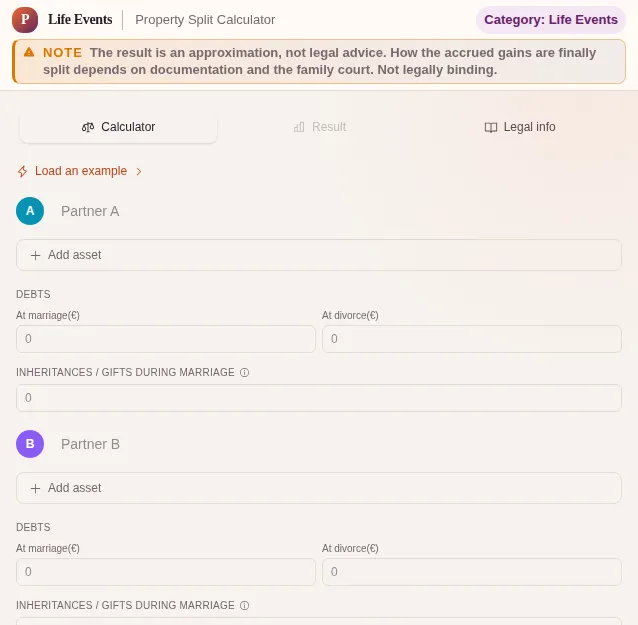
This safe preview shows what the tool is for without running account-only actions.
What Property Split Calculator does
In Germany most married couples without a marriage contract automatically live in the statutory regime of the community of accrued gains. That sounds like a shared pot but is the opposite: during the marriage each remains the owner of their assets. Only at divorce is the account settled - and not the entire assets, only the accrued gain, that is the increase in value each achieved during the marriage. Whoever gained more pays the other half the difference. The calculator makes this logic tangible.
The calculation starts with the initial estate: what did you have on the wedding day? Then the final estate: what do you have on the cut-off date, that is when the divorce petition is served? The difference is your accrued gain (Section 1373 BGB). The calculator lets you capture assets cleanly by category - real estate, bank deposits, securities, vehicles, life insurance, business holdings and other - each with an initial and final value, so nothing slips through.
An often-overlooked point is the privileged acquisition under Section 1374 para. 2 BGB: inheritances and gifts you received during the marriage are added to the initial estate and therefore do not count as accrued gain. That is fair, because this increase in value has nothing to do with the marital effort. The calculator has a dedicated field for it, so your inherited family home is not accidentally treated as shared gain.
Debts are handled correctly too. Liabilities at the start and end of the marriage flow into the respective estate, and since the property-law reform even a negative initial estate is possible - whoever entered the marriage with debts and paid them off has a correspondingly higher accrued gain. The calculator accounts for this and flags when a negative initial estate is present.
The cap under Section 1378 para. 2 BGB matters: the equalization claim is limited to the existing net final estate of the party owing equalization. Nobody has to equalize more than actually exists at the end. The calculator checks this automatically and shows whether the claim was capped and what it would originally have been. Optionally you can also run a modified accrued gain with a different quota, if you have such an agreement.
So you even know what the other party has, there is the duty of disclosure under Section 1379 BGB: both partners must disclose their initial and final estate and provide evidence. The calculator explains this duty and warns about disloyal asset dispositions (Section 1375 para. 2 BGB), that is secretly moving assets away before the divorce. You can save the result as a PDF or copy it. As always: this is a solid orientation, but real-estate valuation, business valuation and the precise cut-off date belong in expert hands.
Features
Initial and final estate
Capture both partners' assets on the wedding day and the cut-off date - the calculator derives the accrued gain under Section 1373 BGB.
Assets by category
Real estate, bank deposits, securities, vehicles, life insurance, business holdings and other - cleanly separated.
Inheritances privileged
Inheritances and gifts are added to the initial estate under Section 1374 para. 2 BGB and do not count as accrued gain.
Debts and negative estate
Liabilities at the start and end flow in correctly, and a negative initial estate is taken into account.
Cap under Section 1378
The equalization claim is capped at the payer's net final estate - the calculator checks and shows it.
Equalization claim to the cent
Who pays whom how much - half the difference in accrued gain, clearly shown with intermediate steps.
Disclosure duty and pitfalls
Notes on the disclosure duty (Section 1379 BGB) and a warning about disloyal asset dispositions (Section 1375 para. 2 BGB).
PDF export
Download the full calculation as a PDF or copy it, ready for a notary or lawyer.
How it works
- 1
Capture the initial estate
Enter for both partners what existed on the wedding day - assets and debts.
- 2
Capture the final estate
Capture the position on the cut-off date, that is when the divorce petition is served, for both.
- 3
Enter inheritances
Enter inheritances and gifts in the dedicated field - they are privileged and added to the initial estate.
- 4
Calculate
The calculator determines both accrued gains, the difference, the equalization claim and checks the cap.
- 5
Save the result
Review the breakdown and download it as a PDF or copy it for the further proceedings.
Who needs this
Frequently asked questions
What is the difference between assets and accrued gain?
In the equalization of gains, not the entire assets are split but only the accrued gain - the increase in value during the marriage. Your gain is the final estate minus the initial estate (Section 1373 BGB). Whoever achieved more gain pays the other half the difference.
Do inheritances count as accrued gain?
No. Inheritances and gifts you receive during the marriage are added to the initial estate under Section 1374 para. 2 BGB (privileged acquisition) and therefore do not count as accrued gain. However, the increase in value of an inherited property can be subject to equalization.
What is the cut-off date for the final estate?
For the final estate the relevant day is when the divorce petition is served on the other spouse. From that point on your assets no longer grow into the equalization. The exact cut-off date is decisive and should be clarified with a lawyer if in doubt.
Can the equalization claim exceed my assets?
No. Under Section 1378 para. 2 BGB the equalization claim is capped at the party's existing net final estate. The calculator checks this automatically and shows when the claim was reduced for that reason.
What happens with a negative initial estate?
Since the property-law reform a negative initial estate is possible. Whoever enters the marriage with debts and pays them off achieves a higher accrued gain. The calculator accounts for debts at the start and end correctly and flags a negative initial estate.
How do I know what my partner owns?
Under Section 1379 BGB there is a duty of disclosure: both partners must disclose their initial and final estate and provide evidence. Anyone who secretly moves assets away risks having them attributed back as a disloyal asset disposition (Section 1375 para. 2 BGB).
Does the calculator replace a notary or lawyer?
No. The calculator provides a solid orientation, but the valuation of real estate and businesses, the precise cut-off date and special cases belong in expert hands. For a binding equalization you need a lawyer or a notary.
Related tools

Pension Splitting Explainer
Understand pension splitting during divorce in Germany.

Support Calculator
Calculate child support (Düsseldorf Table 2026), separation and post-marital support. 3/7 met…

Marriage Contract Explainer
Compare German property regimes, take the "Do I need a prenup?" quiz, explore clauses with un…

Inheritance Tax Calculator
Calculate German inheritance or gift tax by relationship, tax class, and allowance. With full…

Net Worth Tracker
Track your net worth over time. Assets, liabilities, net worth - with trend charts and alloca…

Separation Year Tracker
Track the mandatory separation year before divorce in Germany. Countdown, timeline, checklist…
Ready to use Property Split Calculator?
No installation. Included from Plus. Open it right in your browser.
Open now