

Un coup d'œil à l'intérieur
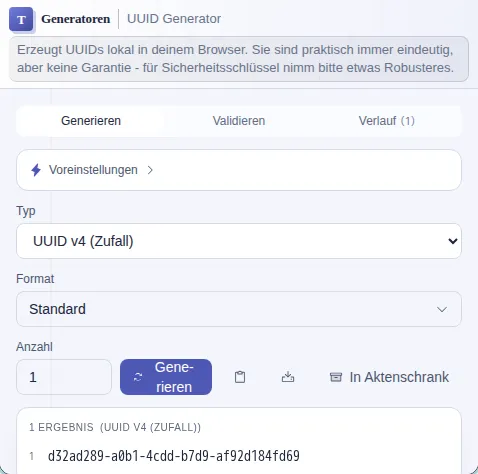
Cet aperçu sécurisé montre à quoi sert l'outil, sans exécuter d'actions liées à un compte.
Ce que sait faire UUID Generator - Générateur d’UUID
A UUID is a number that is practically guaranteed to exist only once - the universal way to give a record, a file or an event a unique identifier without needing a central authority. This generator produces exactly those IDs, and not just one kind but the whole family.
UUID v4 is the standard: purely random, ideal for most cases. UUID v1 is based on time and node, UUID v7 combines a timestamp with randomness and is therefore naturally sortable - perfect as a database key, because records that are close in time also sit close together in the index. On top of that come ULID and Nano ID, two more modern, compact alternatives, with Nano ID even offering a custom length and character set.
The output format adapts. Standard with hyphens, all upper case, without hyphens, in braces for certain Microsoft contexts or as a URN with the urn:uuid prefix. So you get the ID in exactly the notation your code or database expects.
If you need many IDs, generate them in batch - a whole list at once, ready to copy. A validation mode goes the other way: paste an existing UUID and the tool tells you whether it is valid, which version and variant it has and, for v1 and v7, what timestamp it contains.
A local history remembers what you generated last, so you can find an ID again later. Everything is stored only in your browser, nothing travels outside.
The IDs are created cryptographically at random via the Web Crypto API and entirely locally. No server contact, no transmission, no signup. The tool is fast, works offline and is therefore suitable even for sensitive environments where no data may leave the device.
Fonctionnalités
Six ID types
UUID v4, v1, v7, Nil UUID plus ULID and Nano ID - the right type for every use case.
Sortable v7 IDs
UUID v7 combines timestamp and randomness, making it an excellent database key.
Five output formats
Standard, upper case, no hyphens, in braces or as a URN - however your system wants it.
Batch generation
Generate a whole list of IDs at once, ready to copy for seeds or test data.
Validate a UUID
Paste an existing UUID to learn its validity, version, variant and embedded timestamp.
Custom Nano ID
With Nano ID you set the length and character set yourself, for short, URL-friendly identifiers.
Cryptographic and local
Generated via the Web Crypto API, entirely in the browser. No server contact, usable offline.
Comment ça marche
- 1
Choose a type
UUID v4 for the standard case, v7 for sortable keys, or ULID or Nano ID.
- 2
Set the format
Select standard, upper case, no hyphens, braces or URN.
- 3
Set the count
Generate a single ID or a whole batch at once.
- 4
Copy or validate
Copy the result or check an existing UUID in the validation tab.
Pour qui
Questions fréquentes
Which UUID version should I take?
For most cases v4 (purely random) is the right choice. If you need sortable keys for a database, v7 is better because it embeds a timestamp and keeps entries ordered in the index. v1 is based on time and node and is rarely needed today.
Are the UUIDs really unique?
Practically yes. A UUID v4 has 122 random bits, which is so many possible values that a collision is extremely unlikely. For real applications you can treat a v4 UUID as unique.
What is the difference between ULID and UUID?
A ULID embeds a timestamp like UUID v7 and is sortable, but it is shown more compactly as 26-character Base32 text, making it friendlier for URLs and reading. Nano ID is even shorter and fully configurable. Which you pick depends on your system.
Can I check an existing UUID?
Yes. In validation mode you paste a UUID and the tool shows you whether it is valid, which version and variant it has, and for v1 and v7 what timestamp it embeds.
Are the IDs generated on a server?
No. The IDs are created cryptographically at random via the Web Crypto API directly in your browser. No server contact, no transmission, no signup. The tool works offline too.
Outils similaires

Base64 Encoder/Decoder - Encodage et décodage Base64
Text und Dateien in Base64 kodieren oder dekodieren. Direkt im Browser, kein Server-Upload. U…

Hash-Verify - Vérification de hash
Berechne MD5, SHA-1, SHA-256, SHA-384, SHA-512 Hashes und HMAC. Dateien und Texte hashen, ver…

QR-Code Generator - Générateur de codes QR
Erstelle QR-Codes für URLs, Texte, vCards und Wi-Fi-Zugänge. Als PNG oder SVG herunterladen.…

Passwort-Generator - Générateur de mots de passe
Erzeuge kryptographisch sichere Passwörter und Passphrasen. Länge und Zeichensatz einstellbar…
JSON-Formatierer - Formateur JSON
Formatiere, validiere und minimiere JSON mit Syntaxhervorhebung und Fehlererkennung. Kostenlo…

JWT-Inspektor - Inspecteur JWT
Dekodiere und analysiere JWT-Tokens. Header, Payload und Ablaufzeit auf einen Blick.
Prêt pour UUID Generator - Générateur d’UUID ?
Sans installation. Inclus à partir de Plus. S’ouvre directement dans le navigateur.
Ouvrir maintenant