


A look inside
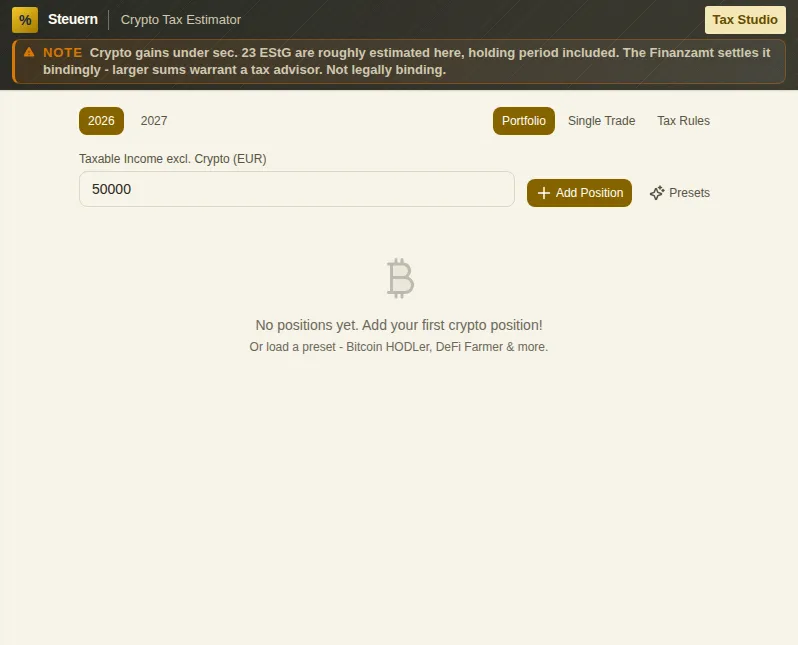
This safe preview shows what the tool is for without running account-only actions.
What Crypto Tax Estimator does
Crypto tax feels complicated because so many different events are treated differently. A sale is not the same as a swap, an airdrop is not the same as a staking yield, and the periods run apart on top of that. The Crypto Tax Estimator builds a clear flow from this: you enter your events, the tool assigns them to the right tax type and estimates what is taxable in the end.
The heart of it is the one-year holding period under Section 23 EStG. Cryptocurrencies you hold for more than 365 days can be disposed of tax-free. The portfolio tracker shows a countdown for each position of how long remains until tax exemption - a small but very practical decision aid before you sell too early and needlessly tax the gain.
For a sale within the year the 1,000 EUR threshold under Section 23(3) EStG applies. If your total private disposal gains stay below it, everything remains tax-free. Exceed it and the entire gain becomes taxable, because it is a threshold and not an allowance. The estimator scales the taxable gain by your personal marginal tax rate so you get a realistic figure instead of an abstract percentage.
Staking, mining, airdrops and lending follow their own rules, and those are exactly what many people confuse. Staking yields are other income under Section 22(3) EStG and taxable from the first euro, with their own threshold of 256 EUR a year. Per the BMF letter of 10.05.2022 only the one-year holding period applies for the later sale of staked coins too. Airdrops are taxed at market value at the time of receipt, and mining can even be classified as a commercial activity subject to trade tax.
The single-trade calculator is for the quick case: one buy, one sell, you just want to know whether this one gain is taxable. The portfolio mode, by contrast, keeps your whole holding in view, including the holding periods. Together they cover the typical situations from the occasional hodler to the active trader.
Everything computes protected, your holdings and prices stay in your control. The estimator is an estimate and not a binding tax calculation - DeFi constructions, NFTs, foreign exchanges or commercial trading can change the classification, and case law keeps evolving. Take the figures as well-founded orientation into your tax return or a conversation with your tax advisor. This is not tax advice.
Features
Portfolio with holding period countdown
For each position you see how many days remain until tax-free disposal after one year.
Single-trade calculator
Fast answer for a single buy and sell: taxable or not, and how large the gain.
Marginal rate, not a flat number
The taxable gain is scaled by your personal marginal tax rate, not by an arbitrary percentage.
Staking and lending
Yields as other income under Section 22(3) EStG with their own 256 EUR threshold - taxable from the first euro.
Mining and airdrops
Airdrops at market value on receipt, mining with a note on possible commercial status and trade tax.
1,000 EUR threshold
The estimator checks the annual threshold for private disposals and warns before it flips.
Transparent legal basis
Every rule names the section and the BMF letter of 10.05.2022 so you can follow the classification.
How it works
- 1
Choose a mode
Use the single-trade calculator for a quick answer or the portfolio tracker for an overview of all positions.
- 2
Enter your events
Buy, sell, swap, staking, mining, airdrop or lending with date, quantity and price - the tool assigns the tax type.
- 3
Set the marginal rate
Enter your personal marginal tax rate so the estimate is realistic rather than flat.
- 4
Read off the estimate
Review taxable gains, thresholds and the estimated tax and check special cases with your tax advisor.
Who needs this
Frequently asked questions
How is tax on crypto gains calculated?
Crypto gains from a sale within one year are private disposal transactions under Section 23 EStG. The taxable gain is added to your other income and taxed at your personal marginal tax rate - there is no fixed crypto tax rate.
What is the holding period countdown?
The portfolio tracker shows for each position how many days remain until the one-year holding period ends. After more than 365 days the sale is tax-free - the countdown helps you decide whether waiting pays off.
How are staking yields taxed?
Staking income is other income under Section 22(3) EStG and taxable from the first euro, with a threshold of 256 EUR a year. For the later sale of the staked coins the normal one-year holding period applies per the BMF letter of 10.05.2022.
Are airdrops taxable?
Airdrops are taxable at market value at the time of receipt as other income. The holding period for a later sale starts from receipt. The exact treatment depends on the individual case.
Can mining be commercial?
Yes. Mining can be classified as a commercial activity, in which case trade tax also applies. For private mining, rules similar to staking apply. When in doubt you should clarify the classification with a tax advisor.
Is the estimate binding?
No. The estimator provides a well-founded approximation. DeFi, NFTs, foreign exchanges or commercial trading can change the classification, and case law keeps evolving. The tool does not replace individual tax advice.
Related tools

Crypto FIFO/LIFO
Estimate crypto gains using FIFO or compare with LIFO. CSV import, lot matching, holding-peri…

Investment Tax Simulator
Simulate investment returns over years. Pre-tax lump sum, partial exemption, gross vs. net -…

Dividend Tracker
Track dividends, interest and capital gains. Tax-free allowance usage at a glance - with char…

Income Tax Calculator
Calculate German income tax per § 32a EStG. Basic and splitting tariff, solidarity surcharge,…

ELSTER Preparation Assistant
Interactive checklist for ESt, USt, GewSt, KSt, and EÜR. Documents by return type, annex find…
Ready to use Crypto Tax Estimator?
No installation. Included from Plus. Open it right in your browser.
Open now